
Plywood vs MDF vs HDHMR vs BWR: Which Board Is Right for Your Home Furniture?
Two quotations for the same modular kitchen. One says "plywood", the other says "HDHMR", and a third quietly mentions "BWR". The prices differ by a lakh or more, and nobody has explained what you are actually paying for. That is the moment most homeowners realise the board behind the laminate matters as much as the laminate itself.
This guide compares plywood vs HDHMR, MDF, BWR and BWP plywood in plain language. You will learn what each board is made of, how they behave around moisture, which one suits kitchens, wardrobes, vanities and TV units, and how to read a quotation so you are not choosing on price alone.
One caution before we start. Board names and grades are used loosely in the market, and performance depends on brand, grade, thickness, adhesive, edge sealing and installation. Where specifications matter, check the manufacturer's datasheet and the certification on the board itself.
Understanding Different Types of Boards Used in Home Interiors
Most modular furniture in India is built from a carcass (the box: sides, shelves, back) and shutters (the visible doors), and the two can use different boards. A laminate, veneer, acrylic or PU finish sits on top. The board underneath decides how the furniture handles screws, humidity and daily use.
What Is Plywood?
Plywood is made by gluing thin wood veneers in layers, with the grain of each layer running at right angles to the next. That cross-layering gives it strength and makes it less likely to warp. Quality varies with the wood species, number of layers, adhesive and manufacturing control.
In India, plywood is graded by how it deals with water: MR (moisture resistant), BWR (boiling water resistant) and BWP (boiling water proof). Plywood is generally strong, holds screws well, and suits load-bearing parts. Limitations: the cut edges and joints are the weak points when wet, and cheaper boards can have voids or inconsistent layers.
What Is MDF (Medium Density Fibreboard)?
MDF is made by breaking wood into fibres, mixing them with resin and pressing them into a uniform sheet. The Indian standard for MDF, IS 12406:2025, covers boards with a density of 600 to 900 kg/m³ and describes MDF as recommended for interior locations. It also describes MR and HMR (high moisture resistance) grades for more humid conditions.
MDF has a very smooth, even surface, so it takes paint, PU and routed designs well. It is also the board that suffers most when water reaches an unsealed edge or surface, where it can swell. That is why it is better suited to dry interiors and decorative parts.
What Is HDHMR (High-Density High Moisture Resistant Board)?
HDHMR is a trade name for a denser, moisture-resistant fibreboard. It is made like MDF, but with a higher-density core and moisture-resistant resins. Greenply describes it as a step above standard MDF that performs where regular MDF would swell or delaminate, and notes that it is not waterproof. Published figures for "HDF" in the 840 kg/m³ and above range appear in some guides, but density varies by brand, so ask for the actual figure.
HDHMR gives a smooth surface for laminates and routing, and is widely used for kitchen and wardrobe shutters and carcasses. Its limits are the same as any fibreboard: exposed cut edges are more vulnerable than the face, and quality differs between brands.
What Is BWR Plywood?
BWR stands for Boiling Water Resistant. It is plywood made with a more water-resistant adhesive than basic MR grade, and is commonly linked to IS 303. Brand guides describe it as suited to humid or semi-humid areas and occasional water contact, not continuous exposure.
What Is BWP / Marine Plywood?
BWP stands for Boiling Water Proof. It is the highest water-resistance grade in the plywood range, usually sold as marine or "710" plywood after IS 710. Manufacturers describe it as made with phenolic adhesive and tested by boiling for extended periods. It costs more than BWR, and is generally recommended for the wettest parts of a home.
A note on standards: IS 303 has been revised, and a BIS document now refers to an IS 303:2024 BWP grade, so labels and certificates can look different from older guides. Always read the certification marking on the board, and ask for the standard and grade in writing.
Plywood vs MDF vs HDHMR vs BWR: Key Differences
The table below gives a qualitative comparison. Brands and grades differ, so use it to understand the categories, not to rate a specific product.
Plywood vs MDF vs HDHMR vs BWR vs BWP
Basis: manufacturer and industry guides (Greenply, CenturyPly, JK Cement, BIS standards) as listed at the end. Qualitative, not test results.
| Parameter | MR plywood | BWR plywood | BWP / marine plywood | MDF | HDHMR |
|---|---|---|---|---|---|
| Composition | Layered veneers, basic adhesive | Layered veneers, more water-resistant adhesive | Layered veneers, phenolic adhesive, highest grade | Wood fibres pressed with resin | Denser fibre core with moisture-resistant resin |
| Strength and durability | Good for dry use | Good | Highest among plywoods | Moderate; depends on density | Good; brand-dependent |
| Moisture resistance | Low to moderate | Good | Highest | Low (standard grade) | Good, better than MDF |
| Water resistance | Not waterproof | Resists splashes, not prolonged exposure | Designed for prolonged water exposure | Weak; swells when wet | Not waterproof |
| Screw-holding | Good | Good | Good | Moderate | Good; check the datasheet |
| Surface finish | Grain can telegraph | Same | Same | Very smooth | Smooth |
| Weight | Lighter than fibreboards of similar size | Same | Same | Typically heavier | Typically heavier |
| Maintenance | Keep dry | Keep edges sealed | Keep edges sealed | Seal edges; avoid wet areas | Seal edges |
| Relative cost | Lower | Mid | Higher | Lower | Between MDF and BWP (per one manufacturer) |
| Typical use | Dry furniture | Kitchens (away from sink), wardrobes | Sink units, vanities, wet areas | Decorative panels, painted shutters | Kitchen and wardrobe carcass and shutters |
None of these is waterproof in the sense of surviving permanent immersion. "Moisture resistant" means a board can handle humidity, steam and the occasional splash. Even BWP boards depend on sealed edges, quality joints and finishes to perform well in real kitchens.
Plywood vs HDHMR: Which Is Better for Kitchens and Wardrobes?
The question "which is better, HDHMR or plywood for a kitchen" has no single answer.
Plywood, particularly BWR and BWP, is the traditional choice for carcasses where strength and water contact matter, such as the sink base. HDHMR gives a smooth surface, takes laminate and routing well, and is a popular mid-priced option for shutters, shelves and carcasses in kitchens that are not directly exposed to water. Greenply's guidance for kitchens suggests HDHMR for shutters and shelving, and BWP plywood for structural carcasses in high-moisture zones, with many premium projects using both.
In a dry wardrobe, either board performs well, and the decision often comes down to budget and brand quality. For a modular kitchen, think zone by zone, which the later section covers.
HDHMR vs MDF: Which Is Better for Home Furniture?
Both are fibreboards, and the difference is in density, resin and moisture performance.
HDHMR vs MDF
Basis: BIS IS 12406 and manufacturer guides. Density varies by brand; ask for the figure on the datasheet.
| Factor | MDF | HDHMR |
|---|---|---|
| Density and composition | Fibreboard, IS 12406 range 600–900 kg/m³ | Denser core with moisture-resistant resin; exact figure varies by brand |
| Moisture resistance | Standard grade is weak; MR or HMR grades exist | Better than standard MDF; not waterproof |
| Durability and strength | Fine for dry decorative parts | Better suited to loaded shelves and humid rooms |
| Finishing and design | Very smooth; excellent for PU, paint and routing | Smooth; works well with laminate and routing |
| Cost | Lower | Higher than MDF, lower than BWP plywood (per one manufacturer) |
| Best for | Dry bedrooms, decorative panels, painted or PU shutters | Kitchen and wardrobe carcasses and shutters |
Choose MDF where the room is dry and you want a smooth, paintable surface. Choose HDHMR where there is some humidity, steam or heavier use. Neither belongs next to a constant source of water.
BWP Plywood vs BWR Plywood: What Is the Difference?
The difference between BWR and BWP is about how well the plywood resists water, which comes down to the adhesive and the standard it is tested against.
BWR (Boiling Water Resistant) is commonly associated with IS 303. It resists humidity and occasional water contact, but is not designed for long exposure to water.
BWP (Boiling Water Proof) is commonly associated with IS 710 (marine grade). It is designed for prolonged water exposure and is tested with boiling water. Greenply describes a 72-hour boil test for BWP grade.
BWR vs BWP Plywood
Basis: Greenply, CenturyPly and BIS references. Standards have been revised, so verify the certificate and marking on the board.
| Aspect | BWR plywood | BWP / marine plywood |
|---|---|---|
| Meaning | Boiling Water Resistant | Boiling Water Proof |
| Typical standard | IS 303 | IS 710 (also referred to under IS 303:2024 BWP grade) |
| Water exposure | Humidity, occasional splashes | Prolonged water exposure |
| Typical use | Kitchen cabinets away from the sink, wardrobes, general furniture | Sink units, vanities, wet areas |
| Relative cost | Lower | Higher |
For most kitchen zones, BWR can be enough; near the sink, many brands recommend BWP. If your budget is limited, spend on BWP only where water exposure is highest, and use a lower grade elsewhere. Do not treat a BWR board as BWP, even if the label looks similar. Ask for the standard, the grade, the brand and the thickness in writing.
Which Is the Best Material for a Modular Kitchen in India?
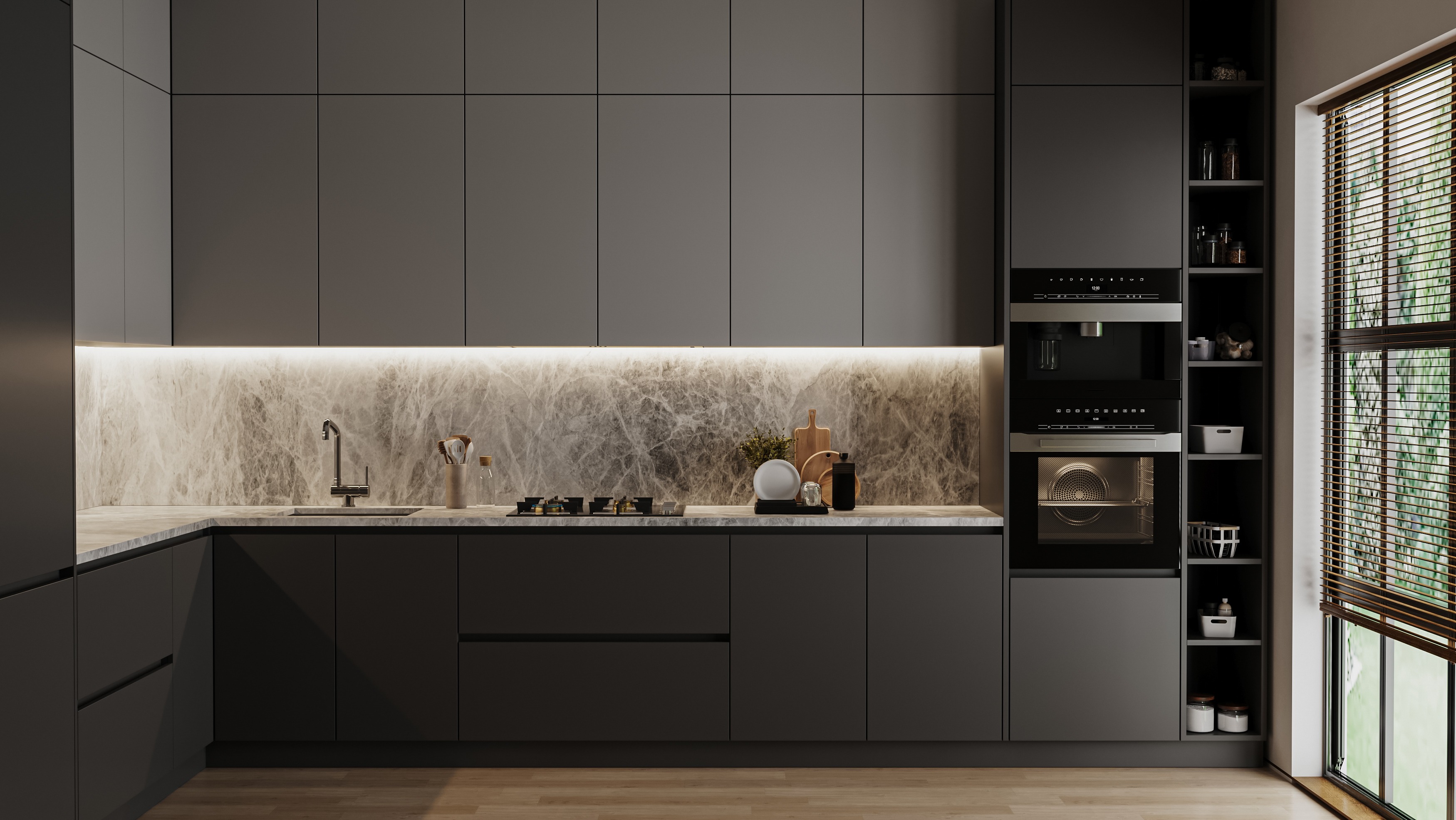
The best material for a modular kitchen depends on each part of the kitchen, because exposure to water, steam and heat differs from one unit to another. That is why a good quotation lists the board by component, not as a single line.
Board Suitability in a Modular Kitchen
Basis: manufacturer guidance and general practice. Conditions vary, so confirm with your designer and the board's datasheet.
| Kitchen component | Better-suited options | Why |
|---|---|---|
| Base cabinets (away from sink) | BWR plywood, HDHMR | Regular steam and spills, but not constant water |
| Sink cabinet | BWP / marine plywood | Highest water exposure from leaks and splashes |
| Wall cabinets | BWR plywood, HDHMR | Less water contact; steam rises |
| Tall pantry units | BWR plywood, HDHMR | Mostly dry storage; weight matters |
| Shutter panels | HDHMR or MDF with laminate, acrylic or PU; plywood where specified | Smooth surface for finishes; edge sealing matters |
| Open shelves | Depends on finish and exposure | Check load and edge sealing |
The underlying rule is simple: match the board to moisture exposure, installation conditions and expected use. A kitchen near a window with strong ventilation behaves differently from a closed kitchen in a humid coastal city.
Which Is the Best Material for Wardrobes?
Wardrobes sit in dry bedrooms in most homes, so the choice is largely about strength, finish and budget.
- Plywood for wardrobe carcasses. Good strength and screw-holding for shelves, partitions and the loft.
- MDF for decorative panels and shutters. The smooth surface suits routed designs, PU and painted finishes.
- HDHMR for selected moisture-resistant applications. Useful for wardrobes in humid rooms, ground-floor homes or coastal areas, and as a mid-budget carcass.
Long-term performance depends on board thickness, hardware, how the shelves are supported and how well the edges are sealed. For sizes and layouts, see our guide to wardrobe design for bedroom.
Which Board Is Best for Different Areas of Your Home?
Board Selection by Area
Basis: general guidance from manufacturer and industry sources. Always check the specification for your own conditions.
| Area | Practical choices | Notes |
|---|---|---|
| Modular kitchen | BWR or HDHMR for most units; BWP at the sink | Seal edges and joints |
| Bedroom wardrobes | Plywood or HDHMR carcass; MDF or laminate-finished shutters | Dry rooms are less demanding |
| Bathroom vanity | BWP / marine plywood; check other water-resistant options with your designer | Highest moisture exposure |
| TV units | MDF, HDHMR or plywood | Mostly dry; MDF is fine for decorative panels |
| Study tables | Plywood or HDHMR | Needs strength and edge durability |
| Crockery units | BWR plywood or HDHMR | Near the kitchen, so some humidity |
| Utility cabinets | BWP or BWR plywood, depending on water exposure | Washing machine and laundry areas get splashes |
Factors to Check Before Selecting a Board Material
- Board thickness. Many designers use 18 mm for carcasses and shutters, with thinner boards for backs, but confirm what is quoted for each part.
- Grade and certification. Look for the standard and grade, such as IS 303 or IS 710, printed or certified on the board, and verify that it matches the quote.
- Moisture exposure. Think about steam, spills, leaks, humidity and your city's climate.
- Adhesive quality. The glue decides how the board behaves when wet.
- Edge sealing. Cut edges absorb moisture first. Ask how edges are banded and sealed.
- Laminate or veneer finish. A good finish protects the face, but not unsealed edges.
- Hardware and screw-holding. Heavy drawers and soft-close hinges need a board that holds screws well.
- Manufacturer specifications. Ask for the datasheet, which shows density, grade and standards.
- Installation quality. A good board can fail with poor joinery or fitting.
Common Mistakes Homeowners Make When Choosing Furniture Boards
- Choosing the cheapest material without checking specifications. A low price may mean a lower grade, thinner board or missing sealing.
- Assuming every moisture-resistant board is waterproof. MR, BWR, HDHMR and BWP behave differently, and none handles unsealed, permanent water.
- Ignoring board thickness. A thinner shelf sags sooner, and a thin carcass holds hardware less securely.
- Not checking the material in the quotation. "Plywood" or "ply" can cover several grades. Ask for the grade and brand.
- Using unsuitable boards near sinks or wet areas. MDF or low-grade ply under a sink is a common source of swelling and damage.
- Ignoring edge banding and sealing. Water enters at cut edges, so sealing is as important as the board.
How to Compare Furniture Material Quotations from Interior Designers
A quotation is only comparable when the specifications match. Here is how to read one:
- Check the exact board type for each part (for example, BWR plywood for base cabinets, BWP for the sink unit).
- Compare thickness and grade. Ask for millimetres and the standard.
- Verify brands. Ask which manufacturer's boards will be used, and for the invoice or board marking at delivery.
- Get specifications in writing. This includes carcass, shutters, back panels, shelves and edge banding.
- Separate carcass from shutter materials. One quote may use plywood carcass with laminate shutters, another HDHMR throughout.
- Compare beyond the final price. Look at hardware, finishes, warranty and who handles after-sales issues.
For how scope and specifications change quotes across the whole home, see our guide to interior design cost per sq ft.
Final Verdict: Which Board Should You Choose for Your Home?
There is no board that wins everywhere, and a sensible specification mixes materials.
- Modular kitchen: BWR plywood or HDHMR for most units, with BWP or marine plywood at the sink.
- Wardrobes: plywood or HDHMR for the carcass, with MDF or laminate-finished shutters, depending on budget and the room's dryness.
- Bathroom vanity or wet utility: BWP or marine plywood, with sealed edges.
- TV units and decorative panels: MDF or HDHMR.
- Tight budgets: spend on the high-exposure parts first, and use lower grades where the board stays dry.
If you are weighing plywood vs HDHMR for your own home, the useful question is not which is "better", but where each part of the furniture sits, how wet it gets and how long you want it to last. Get the board, grade, thickness and brand written into the quotation.
Frequently Asked Questions
1. Which is better, HDHMR or plywood for a kitchen?
Both work, in different places. HDHMR suits shutters, shelves and carcasses away from water, while BWR or BWP plywood suits carcasses near the sink. Many kitchens use both.
2. Is MDF safe for wardrobes?
Yes, in dry rooms, particularly for decorative panels and shutters. For carcasses and humid conditions, plywood or HDHMR is usually a better choice, and edges should be sealed.
3. Which plywood is best for modular kitchens in India?
BWR plywood is commonly used for most cabinets, and BWP or marine plywood for sink units and wet zones. Check the grade, standard, brand and thickness in your quotation.
4. What is the difference between BWR and BWP plywood?
BWR is boiling water resistant and handles humidity and occasional splashes. BWP is boiling water proof and is designed for prolonged water exposure. BWP is usually costlier.
5. Is HDHMR board waterproof?
No. HDHMR is moisture resistant, which means it handles humidity and occasional splashes better than standard MDF, but it is not waterproof. Seal edges and avoid constant water contact.
6. Can MDF be used in kitchen cabinets?
Standard MDF is not recommended where steam or water is likely. If used, it should be limited to dry parts or finishes, and grades such as HMR are better. HDHMR or plywood is usually preferred.
7. Which board lasts longer, plywood or HDHMR?
It depends on grade, brand, installation and exposure. Good BWR or BWP plywood and good HDHMR can both last well. Poor-quality boards, unsealed edges or heavy water exposure shorten life.
8. Which material is best for bathroom vanity cabinets?
BWP or marine plywood with sealed edges is commonly recommended. Ask your designer about other water-resistant options, and avoid MDF in direct wet areas.
9. Is marine plywood worth the extra cost?
It is worth it where the furniture faces regular water contact, such as sink units and vanities. In dry areas, a lower grade can be enough and save money.
10. What board thickness is suitable for modular wardrobes?
Many designers use 18 mm boards for carcasses and shutters, with thinner boards for back panels, but the right choice depends on width, load and hardware. Confirm it in the quotation.
Conclusion
Plywood, MDF, HDHMR, BWR and BWP each have a place, and choosing between plywood vs HDHMR or any other pair comes down to the furniture's location, moisture exposure, load and budget. Check the grade, thickness, brand, adhesive and edge sealing, and read the quotation component by component.
If you are planning your home interiors and want a second opinion on the materials in your quotations, you can talk to the Lakkadworks team about your kitchen, wardrobes and storage. Bring your quotations or specification sheets, and we can walk through the boards and finishes together.
Sources
Board names, grades and standards change. Check the manufacturer's current datasheet and the certification on the board before specifying.
- Greenply Industries (manufacturer guidance on HDHMR, MDF and BWP plywood): greenply.com
- CenturyPly (manufacturer guidance on plywood grades): centuryply.com
- JK Cement (board and material guides): jkcement.com
- Bureau of Indian Standards (IS 303, IS 710, IS 12406): bis.gov.in
Comparing quotations for your kitchen or wardrobes?
Bring your quotes or specification sheets and our team will walk through the boards, grades and finishes with you.