Interior Design vs Interior Decoration: What's the Real Difference?
Written by Lakkadworks Team
Most people use "interior design" and "interior decoration" interchangeably. That's understandable — both deal with how a home looks and feels. But they're not the same thing, and confusing the two is one of the most common reasons people end up with a home that looks good in photos but doesn't actually work to live in.
Quick Answer — Interior design is the process of planning how a space functions — layout, structure, storage, lighting, and electrical systems. Interior decoration is the process of styling a space that already exists — choosing colours, furniture, fabrics, and accessories. Design decides what a room does. Decoration decides how it looks. Across 250+ homes in Gurgaon, Delhi NCR, and Noida, this is the single distinction that separates a home that feels right from one that merely photographs well.
The Core Difference: Function vs. Aesthetics
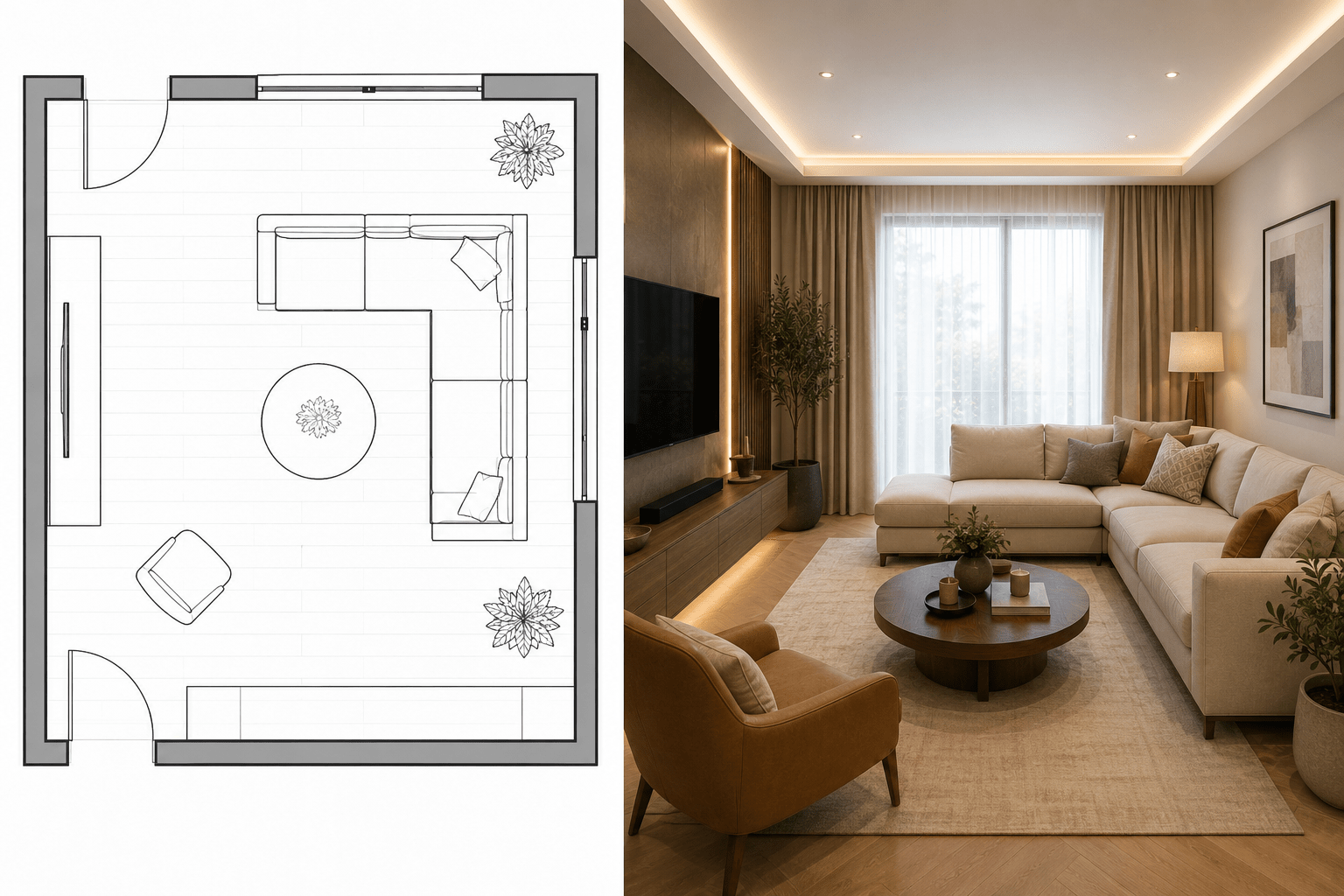
Here's what most people get wrong. They start with how they want their home to look — they find references, choose a colour palette, buy a sofa they love — and then call it interior design. What they've actually done is decoration. Interior design happens before any of that. It's the layer of decisions that determines whether your home will actually work for the way you live — not just for the first two weeks after handover.
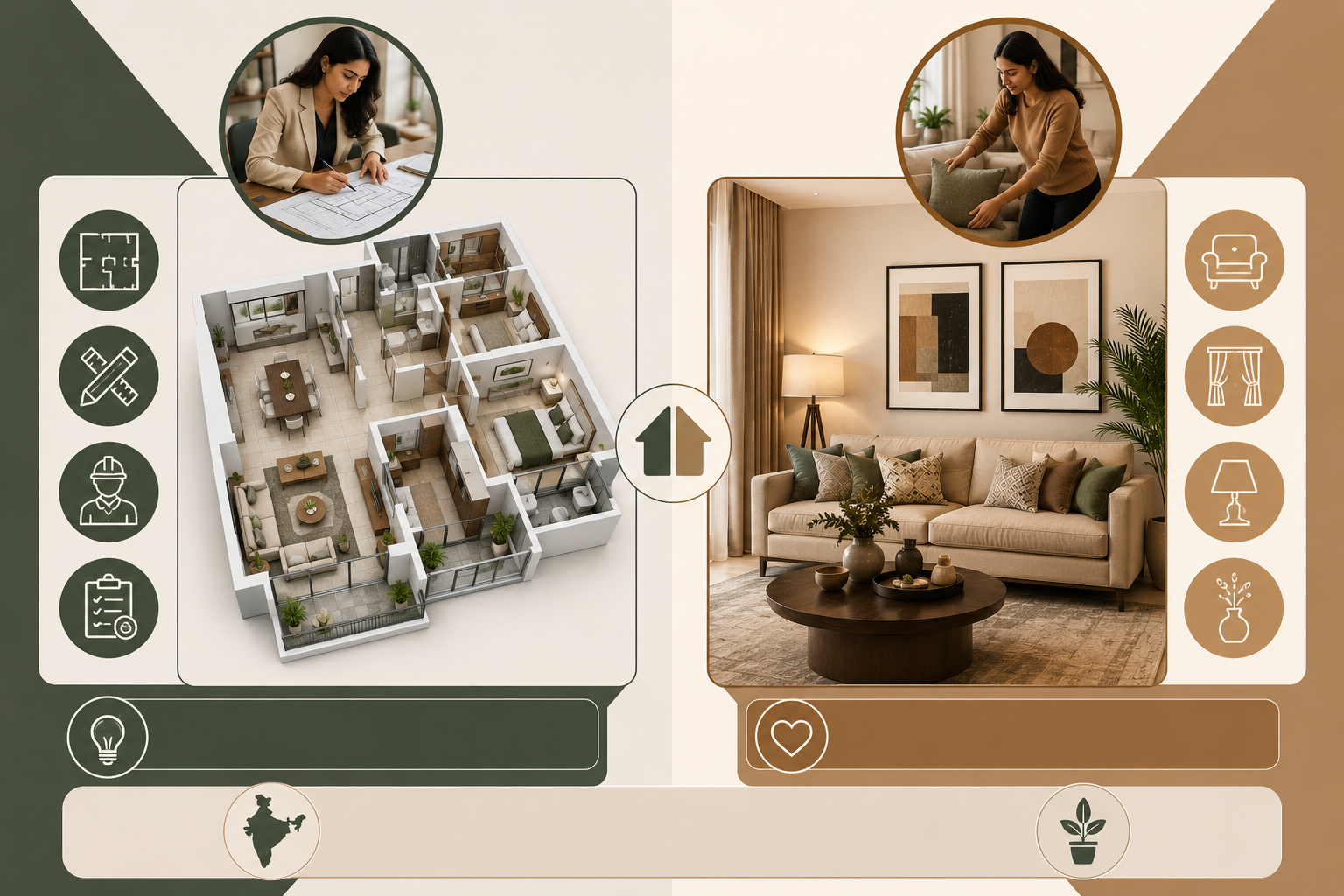
Interior Design Asks
Where should the door open — inward or outward — to avoid blocking circulation?
Is this wall load-bearing, or can it come down to open up the living area?
Where do electrical points need to go so the TV unit, sofa, and study desk all have power nearby?
How much storage does this family actually need, and where does it go?
How does natural light move through this space across the day?
Interior Decoration Asks
What colour palette works for this room's light and size?
Which sofa style suits the space — low-profile or high-back?
Should the curtains be floor-length or sill-length?
What artwork belongs on that empty wall?
Which rug anchors the seating arrangement?
Both matter. But design always comes first — because you cannot decorate your way out of a poorly planned space. We have seen it too many times: a beautifully styled home in a DLF Phase 4 apartment where the sofa blocks the only window, or a Golf Course Road flat where the kitchen looks magazine-worthy but the chimney is positioned on the wrong wall entirely.
What Each Professional Actually Does
What an Interior Designer Does
An interior designer works with the physical structure of a space before anything visible is added. This is not a styling role — it is a technical and coordination role that requires understanding of architecture, materials, electrical systems, and construction sequencing.
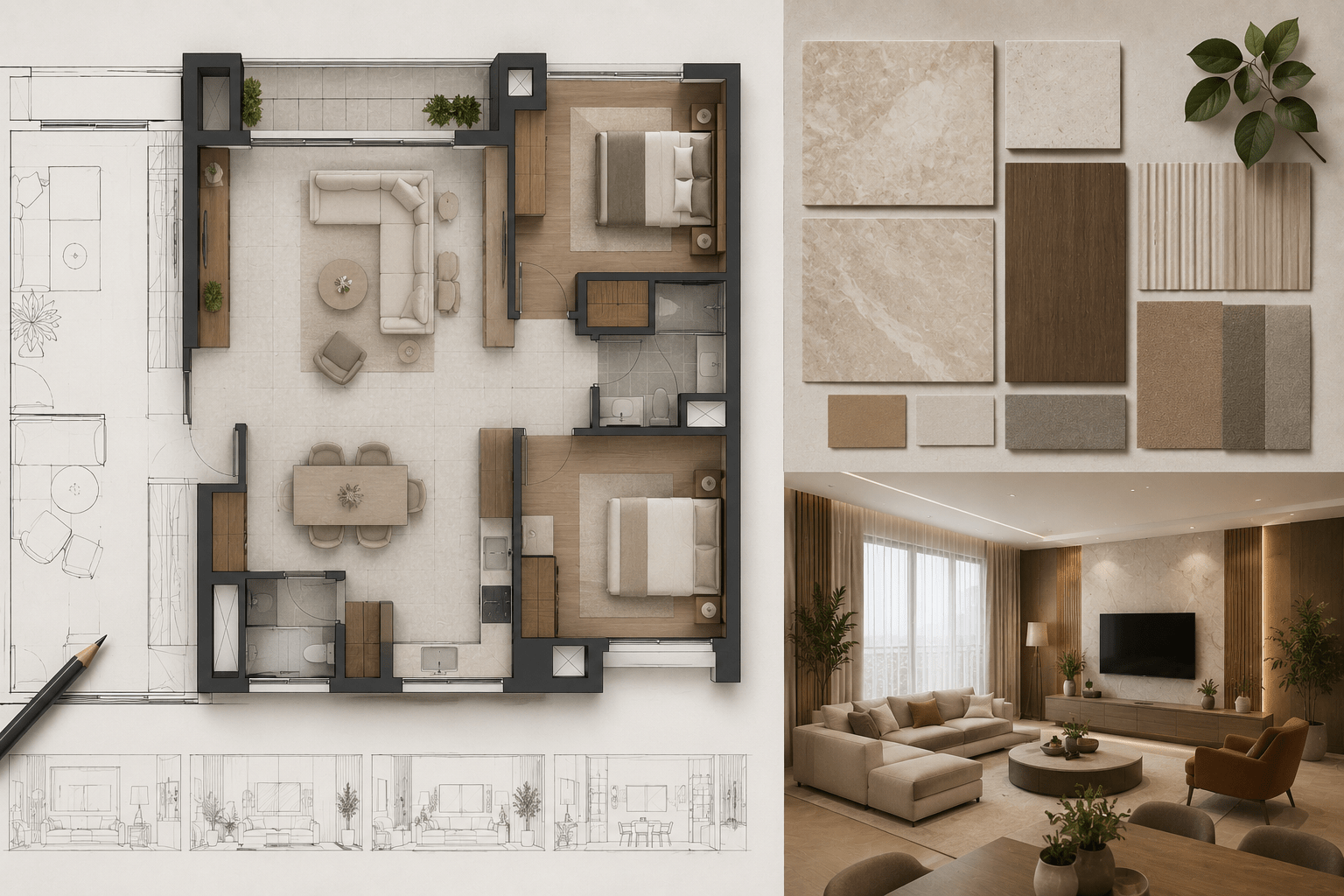
Produces detailed floor plans and layout drawings — not mood boards, actual technical documents
Coordinates civil and electrical work — which walls move, where the conduits run, which switches go where
Designs built-in storage — wardrobes, modular kitchens, TV units, study shelving, all specified to millimetre
Specifies materials at a technical level — not just "wood-look laminate" but the exact plywood grade, laminate brand and finish code, and hardware specification
Manages vendors and timelines — carpenter, electrician, tile contractor, false ceiling contractor, all coordinated under one plan
At Lakkadworks, Sawan Monga leads every project from the first site assessment through to the final snag walk. That continuity — one design intelligence across the full scope — is what separates a coherent finished home from a series of separately executed rooms.
What an Interior Decorator Does
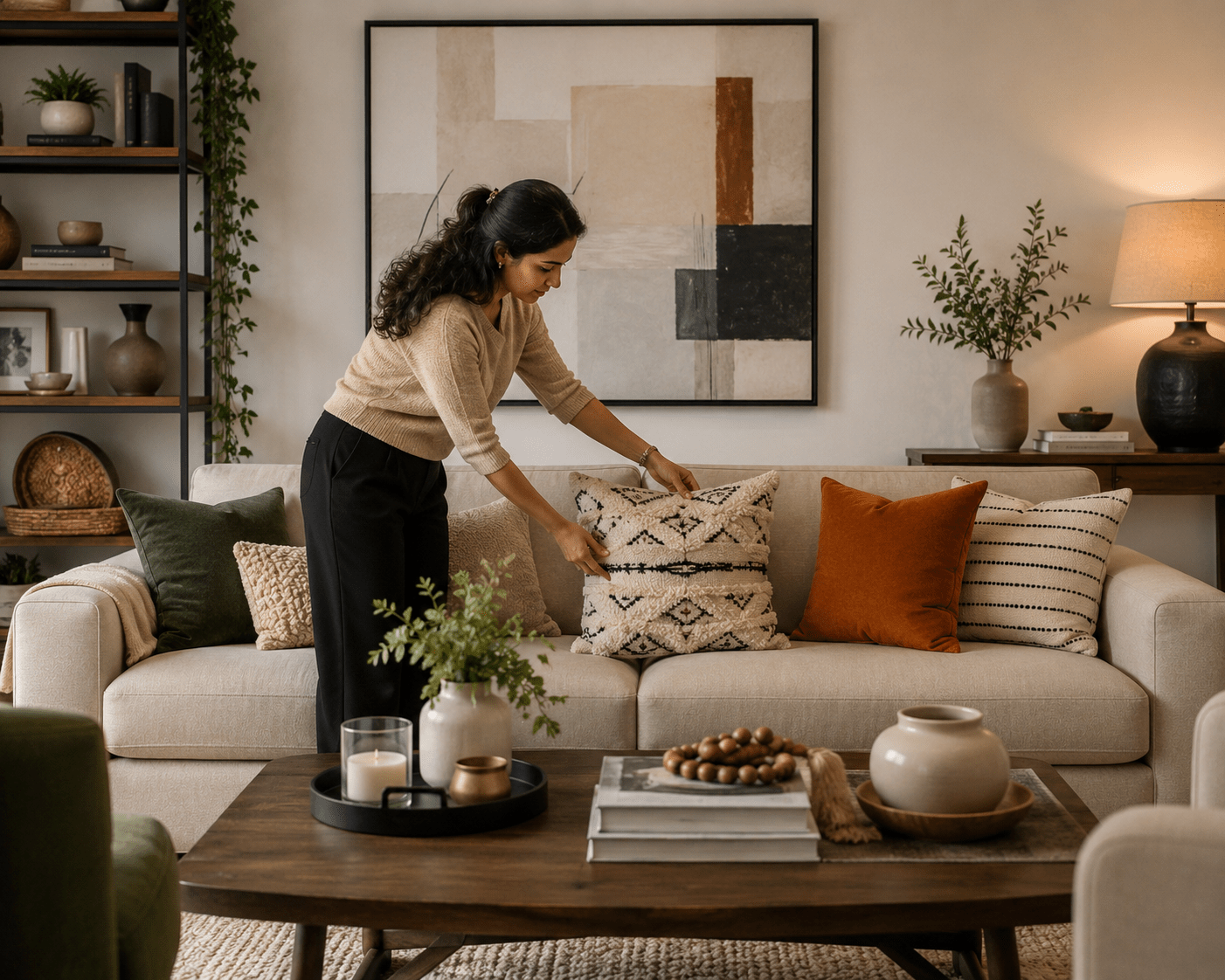
An interior decorator works with what is already there. They do not alter structure, move walls, redesign electrical layouts, or manage civil contractors. Their scope is sourcing and styling: loose furniture, colour schemes and wallpapers, curtains and soft furnishings, artwork placement, and the final composition of surfaces and shelves.
This is a genuinely skilled discipline — the difference between a finished room that feels considered and one that feels assembled. But it is the second half of the process, not the whole of it. Hiring a decorator without a designer is like commissioning the upholstery before the chassis is built.
Why This Distinction Matters Specifically in Indian Homes
In Indian home renovations — and particularly in Gurgaon, Noida, and Delhi NCR — skipping the design phase and jumping straight to decoration is extremely common. It is also the single biggest source of post-renovation regret. Here is what actually goes wrong:
Storage is underestimated every single time. Indian households store significantly more than Western apartment design benchmarks assume — extra utensils, festival items, bedding sets, seasonal clothing, puja room requirements. Without a design-led storage audit from the start, you end up with beautiful cupboards that are not deep enough, or a modular kitchen with nowhere to keep a pressure cooker when it is not in use. We see this in almost every inherited layout we take over in Sushant Lok and Sector 78 Noida.
Electrical points end up in the wrong places. If furniture placement is finalised after the electrician has already wired the flat — which is the norm when decoration precedes design — you will spend years plugging extension cords across the floor. This is not an aesthetic problem; it is a safety and functionality problem that costs significantly more to fix after walls are plastered than before.
Ventilation is treated as an afterthought. Indian kitchens generate heat, oil vapour, spice residue, and moisture at levels that closed modular cabinetry was not designed to handle without proper exhaust planning. A decorator can make your kitchen look immaculate. Only a designer can ensure the chimney is positioned correctly, the exhaust duct is routed efficiently, and the cabinet finishes can actually handle the environment they are going into.
The space feels right but does not work. The most common complaint across renovations that skipped the design phase: the home photographs beautifully, guests compliment it, but living in it daily is inexplicably frustrating. Traffic flow is awkward. One room is always too hot. The kitchen is beautiful but inconvenient. These are design failures — and no amount of decoration fixes them after the fact.
A Practical Way to Think About It
Imagine building a car. Interior design is the engineering — engine placement, chassis structure, safety systems, the mechanical architecture that determines whether the vehicle actually works. Interior decoration is the finishing — upholstery colour, dashboard aesthetics, the quality of the steering wheel trim.
You would not choose the upholstery before the chassis is built. And you would not hand the upholstery brief to the same person who built the engine — their skills are different, their tools are different, their process is different.
The same logic applies to your home. The sequence matters as much as the quality of each stage.
Can One Person or Firm Do Both?
Yes — and for most full home projects in Gurgaon and Noida, a single full-service firm handling both is the right answer. When you engage a turnkey interior company, you are getting design (space planning, material specification, civil coordination, execution management) and decoration (furniture selection, colour palette, styling, finishing touches) under one contract, one timeline, and one point of accountability.
If you hire only a decorator — someone who sources furniture and assembles a colour palette — you are getting the second half of the process. That is entirely appropriate if your space is already well-designed and you are looking for a style refresh. But if you are renovating from scratch or moving into a new flat, starting with decoration alone is working backwards.
The question to ask any firm you are considering: "Do you manage the civil work and carpentry directly, or do you only handle sourcing and styling?" The answer tells you exactly what you are buying.
Qualifications: Is There a Difference?
In India, interior designers are typically trained professionals holding a degree or diploma in interior design, architecture, or a related discipline. The Institute of Indian Interior Designers (IIID) is the apex professional body — membership is one way to verify that a designer is working within a professional framework and has peer accountability.
Interior decorators may or may not have formal training. Many are genuinely skilled stylists with strong aesthetic instincts and excellent supplier networks. But the scope of what they can competently advise on is narrower — they should not be the person making decisions about structural changes, electrical layout, or material specifications for high-moisture environments. Those decisions require technical training, not just taste.
When hiring for a full home project, ask to see examples of technical documents — floor plans, BOQs, material specifications — not just portfolio photographs. Any designer doing real design work will have these readily available.
Which One Do You Actually Need?
Your Situation
What You Need
Moving into a new flat — starting from scratch
Interior Designer (or full-service turnkey firm)
Want a modular kitchen, built-in wardrobes, or false ceiling
Interior Designer — these involve civil coordination
Renovating and want to change layouts or add storage
Interior Designer — structural decisions need design expertise
Full 2–3BHK interior project in Gurgaon or Noida
Turnkey Interior Firm — design + execution under one roof
Home already designed — want a style refresh
Interior Decorator — sourcing and styling scope is appropriate
Interior design is the process of planning how a space functions — layout, structure, storage, lighting, and electrical systems. It happens before any furniture is bought or paint is applied. Interior decoration is the process of styling a space that already exists — choosing colours, furniture, fabrics, and accessories to make it visually appealing. Design decides what a room does; decoration decides how it looks.
Generally yes, because interior design involves civil work, fabrication, and project management — not just sourcing furniture. However, a poorly decorated, well-designed home costs far less to fix than a beautifully decorated, badly planned one. The cost of skipping the design phase — rerouting electrical points, fixing storage that doesn't work, redoing a kitchen that wasn't designed for Indian cooking — typically exceeds what the design phase would have cost in the first place.
Yes. Most full-service designers handle the complete scope — from space planning and execution through to final styling and decoration. The design qualification includes the decoration skill; the reverse is not always true. At Lakkadworks, every project is taken from first site assessment through to the final placement of accessories under one design lead, so the space has a coherent vision throughout.
For a standard residential renovation in India — false ceiling, modular kitchen, wardrobes, electrical rework — you typically do not need a separate architect. An experienced interior designer handles this scope. You would bring in an architect for structural modifications that require building permissions, additions to the property, or new construction. The Council of Architecture India regulates architecture practice if you need to verify credentials.
Ask one question: "Do you manage the civil work and carpentry directly, or do you only source furniture and finishes?" If they manage civil work, they are doing design. If they only source and style, they are decorating. Also ask to see a BOQ (Bill of Quantities) from a past project — a firm doing real design work will have detailed technical documents readily available, not just a portfolio of photographs.
A full interior design project for a 2–3BHK in Gurgaon or Noida typically takes 10–14 weeks from sign-off to handover — this includes civil work, modular fabrication, installation, and final styling. A pure decoration project for a space that is already designed can be completed in 2–4 weeks depending on lead times and the number of items sourced.
Yes — and it is a genuinely smart approach for budget-conscious homeowners. Hire a designer for the planning, layout, electrical coordination, and built-in furniture (the parts that are structurally difficult to undo), and handle loose furniture sourcing and styling yourself. Most interior designers offer a design-only or consultation engagement separate from full execution. This gives you the technical foundation without paying for full project management.
Interior design is not a licensed profession in India the way architecture is under the Council of Architecture Act. However, reputable designers are members of professional bodies like the Institute of Indian Interior Designers (IIID) or hold accredited degrees from recognised institutions. Always verify educational background and completed project references rather than relying on titles alone — the absence of licensing means the quality range is wide.
Modular interiors use factory-manufactured components — kitchen cabinets, wardrobe carcasses, TV units — that are precision-made in a workshop and assembled on-site. They are faster to install, more consistent in finish quality, and typically come with manufacturer warranties on hardware. Custom carpentry is built entirely on-site by carpenters and offers more design flexibility but depends entirely on the skill of the craftsman and typically takes longer. Most full home interior projects in Gurgaon and Noida use a hybrid — modular for kitchens and wardrobes, custom for specific architectural elements.
Interior design in India is most commonly quoted per square foot for the overall project, but this is often misleading because a single per-sqft number bundles very different cost categories together. A more transparent approach is an itemised BOQ — separate line items for civil work, modular furniture, loose furniture, lighting, and design fees. Always request a BOQ before comparing quotes; without one, you have no way of knowing whether two similar per-sqft numbers actually include the same scope of work.
Architecture deals with the structure, form, and construction of a building — the exterior envelope, structural systems, and compliance with building codes and permissions. Interior design deals with the interior spaces within that structure — how they are planned, furnished, and finished. For a new home, an architect designs the building; an interior designer takes over once the shell is complete. For renovation projects in existing apartments, you typically do not need an architect unless load-bearing structural changes or building permissions are involved.
Often yes, and more than most people expect. Non-structural walls can usually be removed or repositioned. Storage can almost always be dramatically improved through well-designed built-ins. Electrical layouts can be reworked during renovation. What cannot be changed without major structural work: bathroom and kitchen positions (plumbing stacks run vertically through buildings), columns and beams, and the overall floor plate dimensions. An honest designer will tell you clearly in the first assessment what is fixable within your budget and what is not — and that clarity is itself worth the consultation.
Interior styling is a narrower discipline focused specifically on how a space is presented for photography, film, or home staging. An interior stylist curates objects, adjusts furniture placement, and creates a visual composition for the camera — it is a temporary, image-focused exercise. Interior design and interior decoration are both about how people actually live in a space day to day. Styling is about how a space photographs. The three disciplines serve different purposes and rarely overlap in practice.
Ideally 2–3 months before your possession date for a new flat, or as soon as you decide to renovate an existing home. Starting after possession — under pressure to move in — is the most common reason projects get rushed, corners get cut, and the final result disappoints. The design and material selection phase alone takes 4–6 weeks before any physical work begins. The earlier you engage, the more considered the outcome and the less stressful the process.
LW
Lakkadworks Team
Interior Design Studio · Gurgaon, Noida & Delhi NCR · 250+ Projects · Led by Sawan Monga
Design First. Always.
Not Sure Where to Begin With Your Home?
We offer a complimentary first consultation and site visit for homeowners across Gurgaon, Noida, and Delhi NCR. We walk through your space, understand your brief and budget, and give you an honest picture of what your home actually needs — design, decoration, or both. No jargon, no pressure.