Turnkey Interiors vs. Design Consultancy: Which Is Right for You?
Written by Lakkadworks Team·Planning & Process·2026 Edition
A straight answer from someone who has run both models — and seen exactly where each one goes wrong.
Why This Question Comes Up in Almost Every First Call
Nearly every homeowner I speak with in the first meeting asks some version of the same thing: should we hand over the whole project, or just get the design and manage the rest ourselves? It's the real question behind turnkey interiors vs design consultancy, and it matters more than most people realise before they've compared full-service interior design against a DIY interior design consultancy model side by side.
The honest answer isn't that one is universally better — it's that a turnkey home renovation suits a certain kind of homeowner, and an end-to-end interior contractor relationship suits a completely different one, and getting this choice wrong is usually what leads to budget overruns, missed timelines, and the endless back-and-forth blame between designer and contractor that nobody wants to deal with mid-project.
Turnkey Interiors vs. Design Consultancy
At the core, turnkey interiors and design consultancy solve the same problem — turning an empty or dated home into a finished one — but they hand you very different amounts of control, risk, and free time in the process.
A turnkey interior design firm takes complete ownership: design, material procurement, civil work, execution, and final handover, all under one contract with one point of accountability. A design consultancy, on the other hand, gives you the layouts, 3D renders, and material specifications, then leaves execution to you — either through your own contractor or vendors you hire and manage directly.
There's also a middle path worth knowing about that most comparison articles skip entirely: semi-turnkey, where the designer handles design and sources materials but you bring in your own execution team. Which of these fits depends far less on budget than most people assume, and far more on how much time, patience, and on-ground presence you can realistically give the project.
What a Turnkey Interior Project Actually Includes
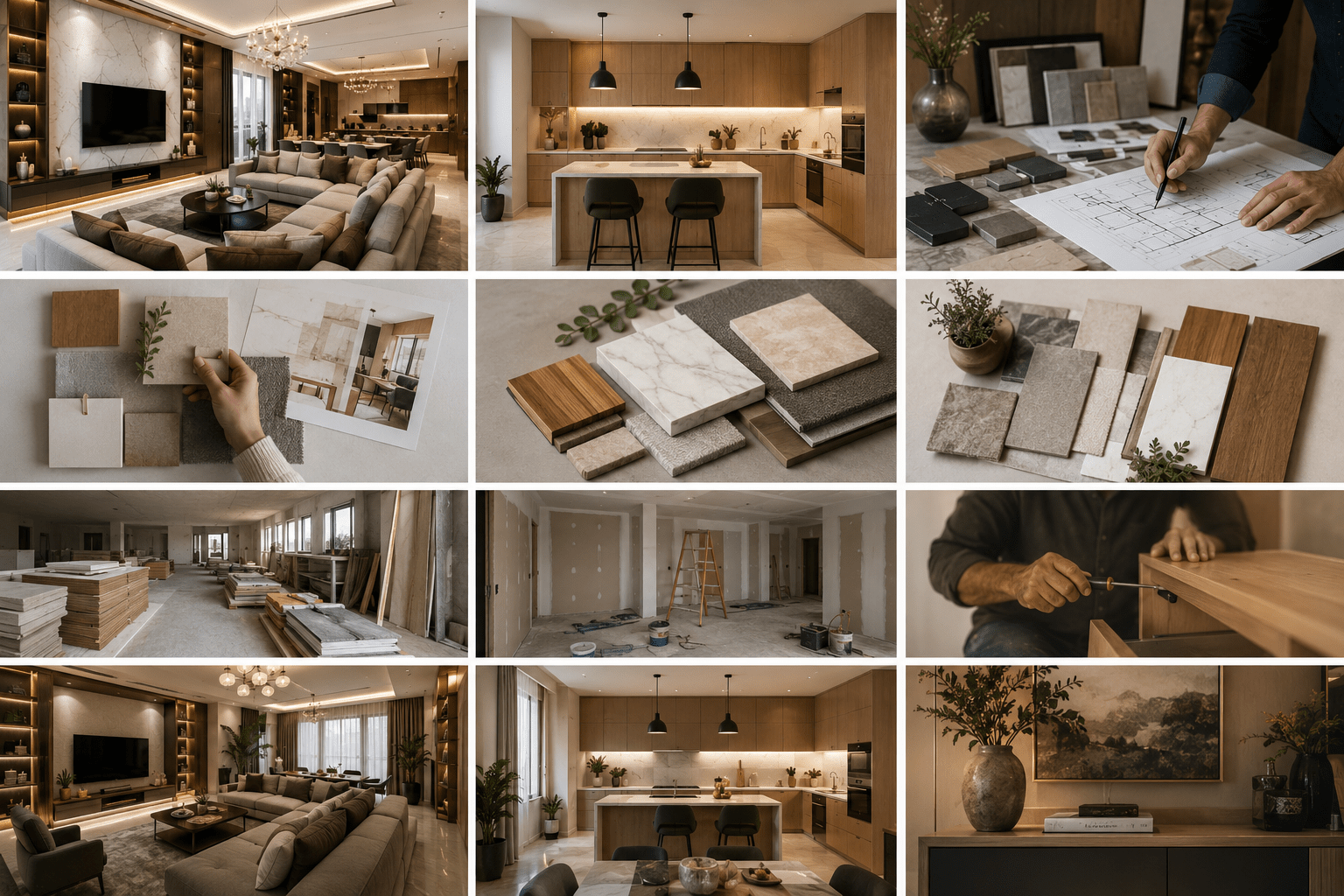
The word gets used loosely, so it's worth being precise. A genuine turnkey interior project means one firm designs the space, sources every material against a fixed Bill of Quantities, deploys its own execution team (or tightly managed subcontractors), handles site supervision daily, and hands you a finished, move-in-ready home on an agreed date — with a warranty on workmanship built into the contract.
Single point of contact for the entire project — one phone number for updates, changes, or complaints, instead of juggling a designer, contractor, electrician, and carpenter separately.
A fixed, contractually binding cost — the price you sign is (in a properly run turnkey project) the price you pay, barring changes you explicitly request mid-project.
Materials sourced and quality-checked by the firm, from an experience centre or curated catalogue, rather than you personally vetting plywood grades and hardware brands at a local market.
Built-in workmanship warranty, typically covering fittings, joinery, and finishes for a defined period after handover.
This is why turnkey interiors now account for a large and fast-growing share of India's interior design market — for busy professionals, NRIs managing a home remotely, or anyone who simply doesn't want to spend weekends chasing a tile vendor, it genuinely removes the chaos.
What Design Consultancy Actually Includes
A design-only consultancy is a narrower, more focused engagement: you're paying for expertise and drawings, not execution. A good consultancy delivers a full layout plan, 3D renders, a detailed material and finish specification, and often a working Bill of Quantities you can hand to any contractor — but the designer typically isn't the one laying tiles or fixing shutters.
Significantly lower fees upfront, since you're not paying for the firm's execution overheads, labour, or material markup — design-only fees are commonly a fraction of full turnkey pricing.
Full control over which contractor you hire, which vendors you buy from, and the pace at which work happens — useful if you already trust a local contractor or want to shop materials yourself for better rates.
Flexibility to execute in phases, spreading cost over months or years, rather than committing to one large upfront payment.
You take on project management yourself — coordinating the electrician, carpenter, painter, and plumber, and resolving the inevitable small disputes between them, unless you separately hire a site supervisor.
This route suits homeowners who have the time to be on-site regularly, already have a contractor relationship they trust, or are working with a tighter budget and want to control spending line by line rather than accept a bundled price.
The Real Cost Comparison — Not Just "Turnkey Costs More"
Most comparison content stops at "turnkey is more expensive," which is only half true and not particularly useful for planning. Design-only consultation fees in India typically range from around ₹50–500 per sq ft, or a fixed fee of roughly ₹25,000–2,00,000 depending on home size and scope, or 5–15% of your total project value if the designer charges on a percentage basis.
Turnkey interiors, because they bundle design, materials, execution, and project management into one number, typically start around ₹1,200–1,800 per sq ft for an economical finish and run ₹1,800–2,800 per sq ft or higher for mid-range to premium finishes — meaning a 1,000 sq ft home might realistically start from ₹12–15 lakh all-in.
Factor
Turnkey
Design Consultancy
Scope
Design + materials + execution + warranty
Design, drawings & specifications only
Upfront fee
₹1,200–2,800/sq ft all-inclusive
₹50–500/sq ft or 5–15% of project value
Typical timeline
60–90 days, design freeze to handover
4–6 months or longer
Accountability
Single point of contact
Split between designer and contractor
Best for
Busy professionals, NRIs, cost certainty
Homeowners with time, a trusted contractor
The number that rarely gets mentioned is what the consultancy route can cost once you add up what the designer's fee didn't include: your own project management time, material price mismatches between what was specified and what's locally available, vendor coordination gaps, and rework from execution errors a full-time supervisor would have caught. None of that shows up in the initial quote comparison, but it shows up in the final bill and, more often, in your stress levels.
Timeline: Who Actually Finishes Faster
Turnkey projects generally move faster in practice, simply because one team controls the entire sequence — carpentry, electrical, and civil work can be scheduled back-to-back without waiting on you to independently coordinate each vendor's availability. A typical 2–3BHK turnkey project runs roughly 60–90 days from design freeze to handover.
Design consultancy projects vary far more widely, since the timeline depends entirely on how quickly you can line up and manage your own contractor — it's not unusual for a consultancy-led renovation to stretch well past 4–6 months once you factor in vendor delays, material reordering, and the inevitable scheduling conflicts between trades that nobody outside the industry expects.
The Middle Path Nobody Talks About: Semi-Turnkey
This is the option most turnkey-vs-consultancy comparisons skip entirely, and it's often the best fit for a large number of homeowners. In a semi-turnkey model, the design firm handles design, 3D visualisation, and material procurement — so you still get quality-checked materials and a single sourcing point — but you bring your own execution labour or a contractor you already trust to do the on-site work, usually at a lower labour cost than the firm's in-house team.
It sits between full turnkey and pure consultancy: more supervision and material accountability than a design-only engagement, but more cost control and execution flexibility than a full turnkey contract. If you're hesitating between the two extremes, this is worth asking any designer about directly, even if it's not listed on their standard pricing page.
What Nobody Tells You About the Risks of Each
Turnkey risks
Less flexibility to shop around for individual materials once you've signed — you're generally working within the firm's vendor network and catalogue.
Higher upfront financial commitment, usually with staged payments tied to project milestones rather than pay-as-you-go.
Quality varies significantly between firms — always ask to see 2–3 completed projects in person, not just renders, before signing.
Design consultancy risks
No single party is accountable if something goes wrong between the design intent and the execution — a common source of disputes when a contractor claims the drawing was unclear and the designer claims the execution was careless.
Material costs can run over the original estimate if local rates differ from what was specified, since the designer isn't the one purchasing on your behalf.
Requires real time investment from you — site visits, vendor coordination, and decision-making on the spot when issues come up, which most working professionals underestimate going in.
A Simple Way to Decide
Choose turnkey if: you're short on time, live outside the city or country during the renovation, want one contract and one warranty, and prefer cost certainty over granular control.
Choose design consultancy if: you already have a contractor you trust, want to control spending material-by-material, have the bandwidth to be on-site regularly, and are comfortable managing multiple vendors.
Choose semi-turnkey if: you want professional design and material sourcing but prefer to bring your own execution team to manage labour costs.
If you're still unsure which bucket you're in, that's a completely normal place to start from — it's usually clearer after one honest conversation about how much time you can realistically give the project, rather than how the finished home should look.
Common Mistakes I See Homeowners Make With Both Models
Comparing a turnkey quote to a design-only quote as if they're the same thing, then being surprised when the "cheaper" consultancy route costs more once execution is added in.
Signing a turnkey contract without a clear, itemised Bill of Quantities — vague contracts are where cost disputes start.
Hiring a design consultancy without confirming upfront who is responsible for site supervision — assuming the designer will visit regularly when that wasn't part of the scope.
Choosing based on the lowest quote alone, without checking either the turnkey firm's completed projects or the consultancy's contractor recommendations.
Not asking about a semi-turnkey option when full turnkey feels like too much commitment and full consultancy feels like too much work.
The most common trap: comparing a turnkey quote to a design-only quote as if they cover the same scope. They almost never do.
Getting This Decision Right the First Time
There's no universally correct answer to turnkey interiors vs design consultancy — only the answer that matches how much time you have, how hands-on you want to be, and how much certainty you need around cost and timeline. What matters is going in with your eyes open about what each model actually includes, rather than comparing two numbers that represent completely different scopes of work.
At Lakkadworks, we offer both full turnkey and design-consultancy engagements, plus the semi-turnkey middle path most firms don't mention upfront — because the right model genuinely depends on your situation, not ours.
Turnkey interior design means one firm handles the entire project — design, material procurement, civil work, execution, and final handover — under a single contract. You receive the keys to a fully finished, move-in-ready home, which is where the term "turnkey" comes from.
Turnkey includes design plus complete execution under one contract and one point of accountability. Design consultancy covers only the design, layouts, and material specifications — you or your own contractor handle the actual execution and site work.
Design consultancy has a lower upfront fee since it excludes execution costs, typically ₹50–500 per sq ft or a fixed fee of ₹25,000–2,00,000. However, once you add your own project management time, material sourcing, and potential rework, the total cost can come close to or exceed a turnkey quote, which usually starts around ₹1,200–1,800 per sq ft all-inclusive.
Turnkey interiors typically start around ₹1,200–1,800 per sq ft for an economical finish and range up to ₹2,800 per sq ft or more for mid-range and premium finishes, depending on the city, materials, and level of customisation.
Semi-turnkey is a middle-ground model where the design firm handles design, 3D visualisation, and material procurement, but you bring your own execution labour or contractor to carry out the on-site work — offering more cost control than full turnkey with more material accountability than pure consultancy.
Turnkey is generally worth it if you have limited time, live away from the project site, or want a single point of accountability and a workmanship warranty. It removes the need to personally coordinate multiple vendors, though it typically requires a higher upfront financial commitment.
Yes — most interior design firms offer design-only consultancy packages that include layouts, 3D renders, and material specifications, leaving execution to you or a contractor of your choice. This is common for homeowners who already have a trusted contractor or want to manage costs directly.
A typical 2–3BHK turnkey project takes roughly 60–90 days from design freeze to handover, since one team controls the entire sequence of work without waiting on separately coordinated vendors.
Timelines vary far more with design consultancy, since execution depends on your own contractor's availability and coordination. It's common for these projects to take 4–6 months or longer once vendor delays and scheduling conflicts between trades are factored in.
In a genuine turnkey contract, the firm you signed with is solely responsible for design, materials, and execution, since everything falls under one point of accountability — this is one of turnkey's biggest advantages over managing multiple separate vendors.
This is less clear-cut, since the designer and the contractor are separate parties. Disputes commonly arise over whether an issue stemmed from unclear drawings or poor execution, which is why it's important to clarify site supervision responsibilities before starting.
In most cases, yes — a genuine turnkey package includes modular furniture, wardrobes, kitchen cabinetry, and often soft furnishings as part of the fixed quote, though it's worth confirming exactly what's included in the Bill of Quantities before signing.
A Bill of Quantities (BOQ) is an itemised list of every material, fitting, and quantity included in a project, along with its cost. It's the document that turns a vague quote into a specific, verifiable contract, and you should insist on one regardless of which model you choose.
It can be, since it lets you control spending material-by-material and shop for better rates yourself. However, it only saves money if you also have the time to manage vendors carefully — without that time, cost overruns from coordination gaps can offset the savings.
Percentage-based design fees in India commonly range from 5–15% of the total project value, though this varies by designer experience, city, and project scope. Some designers instead charge a flat per-square-foot or fixed project fee rather than a percentage.
It's possible but not ideal — mid-project handovers usually mean the turnkey firm has to review and sometimes redo parts of the existing design or execution plan, which can add cost and delay. It's better to decide the model upfront after an initial consultation.
Most reputable turnkey firms include a workmanship warranty covering fittings, joinery, and finishes for a defined period after handover — typically mentioned in the contract. Design-only consultancy generally doesn't include an execution warranty, since the firm isn't responsible for the physical work.
Ask to see 2–3 completed projects in person (not just renders), request an itemised Bill of Quantities, confirm the payment schedule against project milestones, and clarify exactly what warranty is included and for how long.
Yes — turnkey models are common for commercial fit-outs as well, often reducing hidden costs from delays and vendor coordination gaps that can otherwise add 10–20% to a multi-contractor commercial project.
Turnkey is generally the better fit for NRIs or homeowners who can't be physically present regularly, since it offers a single point of contact, remote progress updates, and one accountable party — removing the need for in-person vendor coordination.
LW
Lakkadworks Team
Interior Design Studio · Gurgaon, Noida & Delhi NCR · 250+ Projects · Led by Sawan Monga
Start with the Right Model
Turnkey, Semi-Turnkey, or Design Consultancy? Let's Find the Right Fit for You.
We offer a complimentary consultation for homeowners across Gurgaon, Noida, and Delhi NCR. We walk through your timeline, budget, and how hands-on you want to be — then tell you honestly which model fits your project.